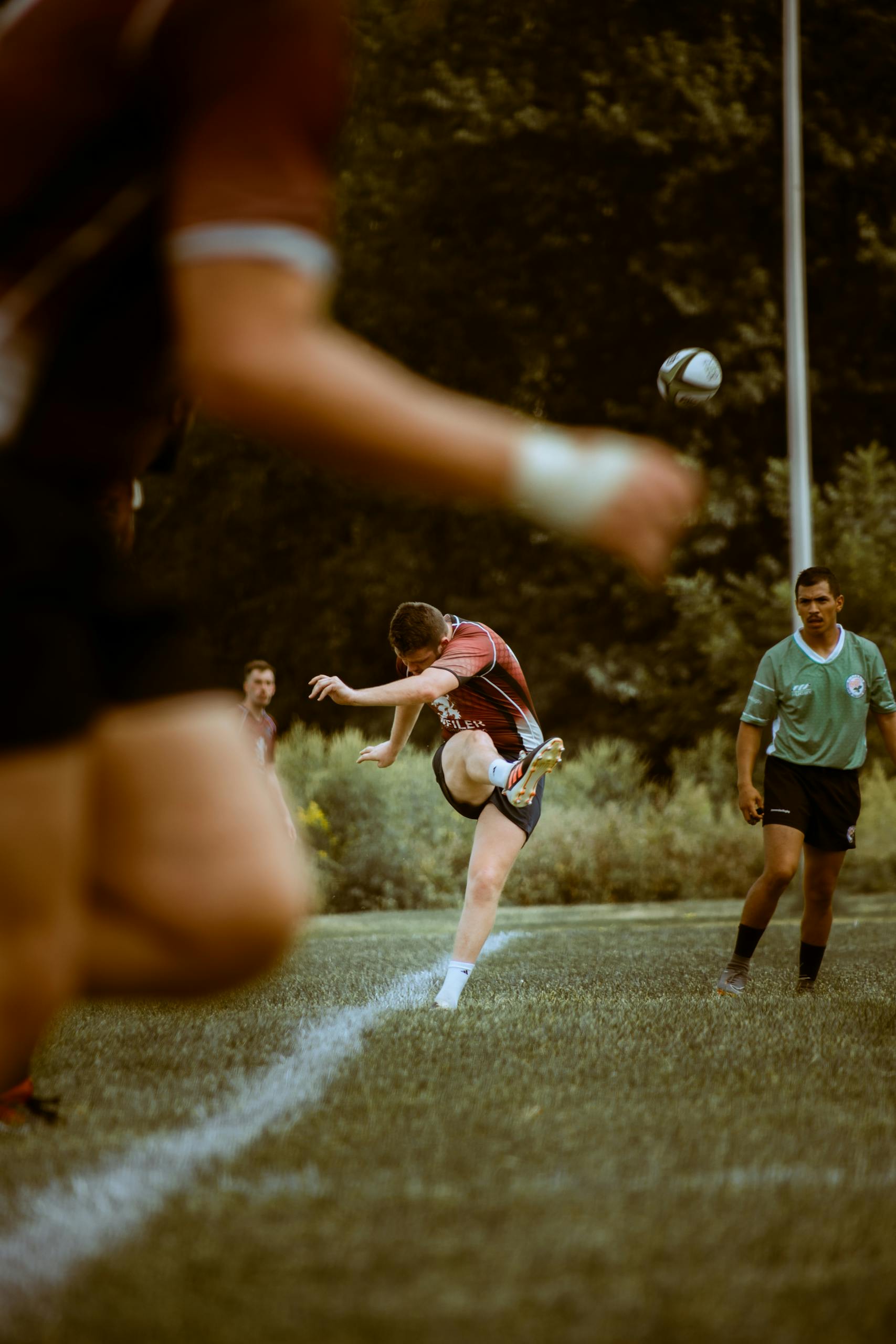
Do Rugby Helmets Actually Exist?
October 15th 2025
Why We Wear Helmets at All
Helmets are among the most effective safety innovations in sport and transport. When used correctly, a helmet dramatically reduces the risk of serious head injury or death.
According to the Insurance Institute for Highway Safety, wearing a helmet reduces the risk of head injury by 69 percent and the risk of death by 42 percent. A hospital study in Jamaica found a 40 percent reduction in mortality among helmet wearers. These results are consistent across studies worldwide — helmets save lives.
The Spectrum of Head Impacts
Not every impact to the head is the same. Broadly, they fall into three levels.
Major impacts: like motorcycle or downhill crashes, can fracture the skull or cause fatal injury. Helmets in these sports use hard shells and crushable foam to absorb enormous force.
Medium impacts: such as head-on collisions in rugby or football, can cause concussions without fracturing the skull.
Sub concussive impacts: are smaller, repeated knocks that add up over time. They don’t cause immediate symptoms but are linked to long-term brain effects.
How Helmets Keep Us Safe
Helmets are energy management systems. When a fall or collision occurs, a helmet’s job is to spread and absorb impact before it reaches the skull.
- The hard outer shell disperses impact force across a larger area and prevents sharp or uneven objects from fracturing the skull.
- The inner foam liner compresses to absorb kinetic energy, slowing the impact and reducing the peak acceleration transmitted to the brain.
That combination — distribute, then absorb — is what makes hard shell helmets so effective in activities like cycling, skiing, and motorcycling. Although they significantly reduce the risk of serious head injuries, helmets were not originally designed to prevent concussions. That’s beginning to change, with advances in cycling, skiing, and football equipment now focusing more on rotational impact and brain movement inside the skull.
Soft Shell Headgear: Flexible Protection for Lower-Impact Scenarios
A soft shell headguard trades rigidity for comfort, flexibility, and in some cases safety, as in rugby. These products use energy absorbing foam in a pliable package to provide moderate protection against minor collisions or accidental contact.
You’ll find soft shells in several settings:
- Rugby, where impacts come from other players, not barriers or the ground.
- Soccer and flag football, where lightweight headgear helps reduce cuts and head clashes.
- Surfing and water sports, where impacts are from boards and water, not hard surfaces.
- Medical use, protecting individuals prone to falls or seizures.
- American football practice, where add-ons like the Guardian Cap are used over helmets to reduce impact exposure during training. See the study: Efficacy of Guardian Cap Soft Shell Padding.
Unlike hard helmets, soft shells aren’t designed to resist penetration because that risk doesn’t exist in these scenarios. Their job is to cushion low-level contact, not to deflect sharp objects or high-speed impacts.
This balance of comfort, compliance, and flexibility is exactly why soft shells make sense for rugby.
The Scrum Cap: Rugby’s Unique Approach
The scrum cap is a rugby-specific form of soft headgear with a tightly defined purpose. Under World Rugby’s headgear specification, approved designs are meant only to reduce cuts, abrasions, and cauliflower ear.
They are not designed to prevent concussions, and every manufacturer must display this disclaimer:
“This headgear has been designed to reduce the risk of cuts and abrasions to the wearer’s body only.”
World Rugby’s Regulation 12 also sets strict technical limits, including:
- Maximum padding thickness: 12 mm
- Minimum transmitted acceleration: 200 g during impact testing
That second point is unusual. Most helmet standards aim to reduce the amount of force reaching the head. World Rugby’s specification, however, requires a minimum of 200 g — effectively limiting how protective headgear can be. It’s a rule that made sense when equipment was simpler, but technology has moved on. Modern materials now make it possible to rethink what safe, soft protection can be.
For a clear overview, see the BBC explainer on headgear in rugby: Scrum Caps Explained – BBC Sport.
Why Rugby Doesn’t Use Hard Helmets (and Why That’s Sensible)
Rugby is a contact sport where almost no mandatory equipment is worn, not even shoulder pads or chest protection. Players tackle, ruck, and scrum with full body contact. Introducing a hard shell helmet into that environment would create a new hazard; the potential to injure others.
In rugby, most impacts occur between players, not between players and the ground. A rigid outer shell could cause significant harm in head-to-head or head-to-body collisions, particularly since opponents wear no equivalent protection. That’s why World Rugby insists that all approved headgear must remain soft, compressible, and deformable on contact.
We answer this in more detail in our Rugby FAQ section, including why helmets aren’t part of the sport.
Rugby Headgear Compared: Helmet, Headguard & Scrum Cap
Hard Shell Helmet | Soft Shell Headguard | Current Rugby Scrum Cap | |
Primary Purpose | Prevent skull fractures and manage major impacts | Cushion low-impact collisions | Reduce cuts, abrasions, and protect ears. Not a rugby helmet |
Impact Level | Major – catastrophic impacts (e.g. motorcycle crash, downhill fall) | Medium – concussive impacts (e.g. moderate fall, head contact with a shoulder) | Low – repeated knocks and surface contact |
Structure | Hard outer shell with crushable foam liner | Flexible foam exterior | Thin regulated padding, up to 12 mm |
Impact Focus | Distribute and absorb high-energy impacts | Moderate energy dispersion | Minimal absorption by design (≥ 200 g transmitted) |
Penetration Resistance | Yes, protects against sharp objects | Not designed for penetration | Not designed for penetration |
Typical Use | Motorcycling, cycling, skiing | Rugby, soccer, flag football, medical | Rugby match play under current laws |
Add-On Padding in Contact Sports
Products like the Guardian Cap aren’t replacements for helmets; they are additional layers designed to reduce the force of impacts during training. The MDPI pilot study found that the Guardian Cap reduced linear head acceleration by up to 33 percent during football practice.
This concept of soft-on-hard layering highlights how flexible materials can enhance energy absorption when paired intelligently with rigid systems. It’s an evolving area of design that’s already influencing how researchers think about hybrid protection, and what might come next for rugby.
Where Rugby Head Protection Can Improve
There is growing potential to apply lessons from helmet science to rugby headgear. Advanced materials, layering strategies, and a better understanding of rotational and repeated low-energy impacts could lead to improved protection without changing the nature of the sport.
The goal isn’t to harden rugby. It’s to design soft, flexible protection that’s measurably safer while staying true to the game’s philosophy of open, close-contact play.
This is the challenge, and the opportunity, for the next generation of rugby headgear.
Final Thoughts
So ultimately, there isn’t really such a thing as a rugby helmet , at least not in the way most people imagine.
What many call a “rugby helmet” is actually a scrum cap or soft headguard, designed to prevent cuts and cauliflower ear, not concussions or skull fractures. Rugby’s laws specifically ban hard-shell helmets because they’d pose a danger to other players.
Each form of head protection serves a specific purpose, shaped by the environment and risks it’s designed for. Rugby’s approach has always been minimalist, prioritising technique, awareness, and respect for the physical contest. But as technology evolves, it’s worth asking whether soft protection can also be smart protection.
That’s where the next step lies: building headgear that fits rugby’s philosophy while quietly raising the standard of safety for everyone on the field.
Curious why rugby players compete without hard helmets? We explain the full story, from laws of the game to player behaviour, in Why Rugby Players Don’t Wear Helmets
References
- Headgear Specification, Approved Equipment (World Rugby): https://www.world.rugby/the-game/facities-equipment/equipment/specifications/headgear
- Efficacy of Guardian Cap Soft Shell Padding on Head Impact Kinematics in American Football: Pilot Findings (MDPI): https://www.mdpi.com/1660-4601/20/21/6991
- Scrum Caps Explained – BBC Sport: http://news.bbc.co.uk/sport2/hi/rugby_union/rules_and_equipment/4204674.stm
- What Is a Soft Shell Football Helmet? (Battle Sports): https://www.battlesports.com/blogs/news/what-is-a-soft-shell-football-helmet
- Motorcycle Helmets Overview (IIHS): https://www.iihs.org/topics/motorcycles#helmets
- Jamaica Hospital Study on Motorcycle Helmets and Mortality (PMC): https://pmc.ncbi.nlm.nih.gov/articles/PMC2746805/
Let’s Tackle Rugby Concussions Together
At Pro’Tech Rugby, we’re committed to genuinely building a safer future for the game we love. Our research and innovation are guided by trusted science and real-world rugby experience.
– The Pro’Tech Rugby Team
Explore more at ProTechRugby