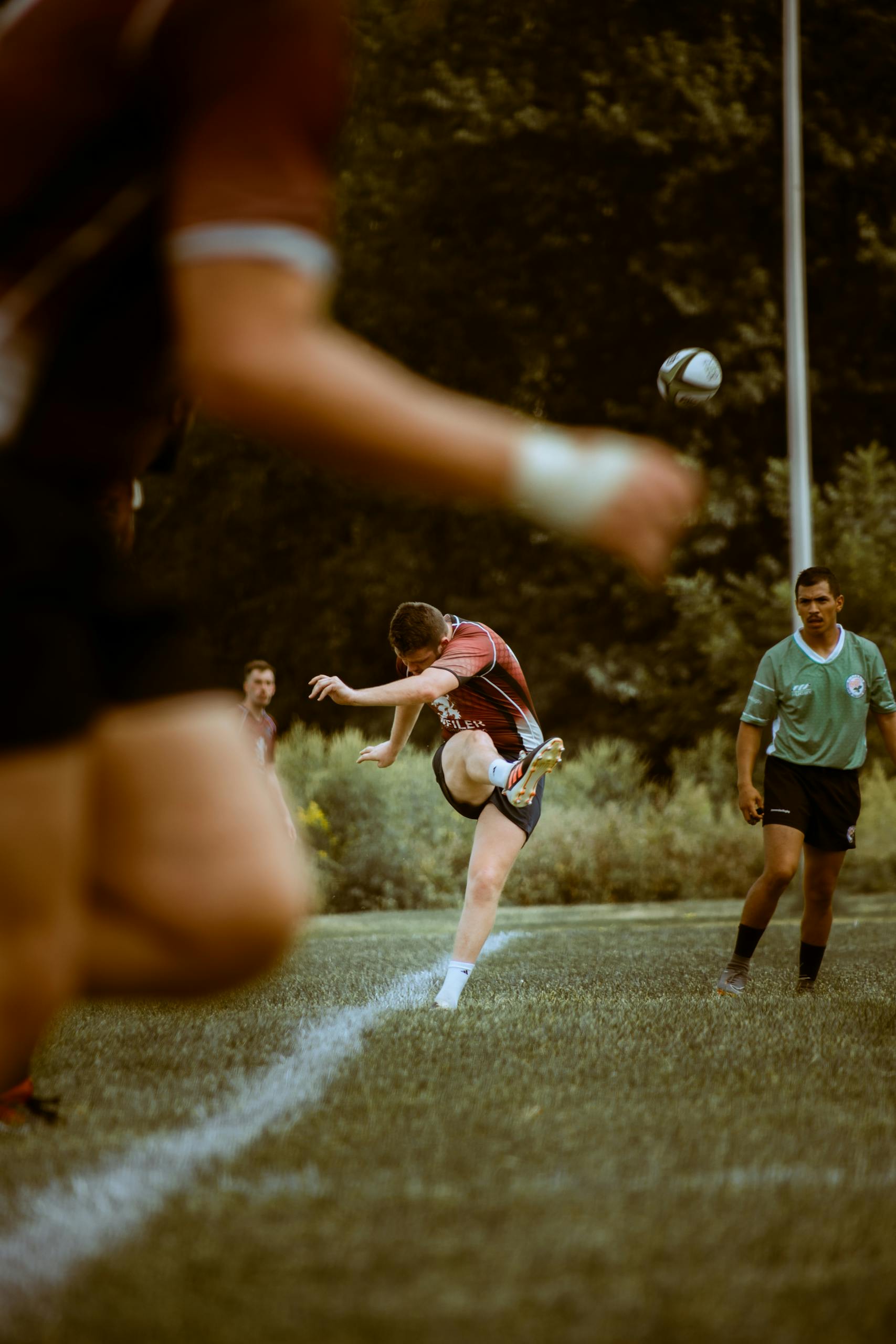
Rugby Scrum Caps and Concussion: What the Evidence Shows
September 25th 2025
Introduction: The Big Question
Parents, players, and coaches often ask: do rugby scrum caps reduce the risk of concussion? It’s an important question. Concussion is one of the most common and serious injuries in rugby, and the idea of protective headgear feels like a natural solution.
The reality is more complicated. Traditional scrum caps have been around for decades with little change, and while they offer some protection against cuts and abrasions, the evidence shows they do not meaningfully reduce concussion risk.
What Rugby Scrum Caps Are Designed For
Scrum caps were introduced to prevent superficial injuries such as cuts, abrasions, and cauliflower ear, particularly for forwards in the scrum.
World Rugby’s regulations are explicit: approved headgear “is not intended nor expected to protect against any form of mild traumatic brain injury” . For years, strict limits on foam thickness and density (around 10–12 mm) have constrained their design.
In other words, traditional scrum caps were never designed to stop concussions, and their construction reflects that purpose.
Do Scrum Caps Prevent Concussions?
Laboratory Findings
When tested in laboratories, traditional scrum caps show some measurable benefits:
- Peak linear acceleration (PLA): Reduced by roughly 25–40 percent compared to a bare headform.
- Peak rotational acceleration (PRA): Reduced by about 15–25 percent, a smaller effect.
- Concussion metrics: Both Head Injury Criterion (HIC) and Rotational Injury Criterion (RIC) were lowered modestly, but values still remained in ranges associated with concussion risk .
In short, traditional caps reduce impact forces at the surface but do not eliminate the mechanics that cause concussion.
On-Field Evidence
Large-scale match studies confirm this limitation:
- A randomized controlled trial with thousands of youth players found no difference in concussion rates between those who wore caps and those who did not.
- A professional case-control study of 417 concussions found headgear use had no effect on concussion incidence or recovery time .
This aligns with the lab findings: the reductions are measurable, but not enough to prevent brain injury in real play.
What Population Data Shows
Concussion is consistently one of rugby’s most common injuries, accounting for around one in five match injuries at the professional level .
In adult community men’s rugby, surveillance studies in England report about 1.5–2 concussions per 1,000 player match hours. Converted into match exposure, that means on average one concussion occurs somewhere across every 12–18 adult games. In youth rugby, rates are higher, at 4.8–9.2 per 1,000 hours, equating to about one concussion every 3–6 matches.
Headgear use has not been associated with lower concussion rates in these large populations. A player’s concussion history remains the strongest predictor of future risk, not whether they wear a scrum cap.
Expert and Governing Body Views
- World Rugby: Headgear is for cuts and abrasions, not concussion prevention.
- England Rugby (RFU): The HEADCASE programme is clear that scrum caps do not reduce concussion risk.
- Medical consensus: Emphasis is placed on technique, law changes (such as tackle height adjustments), and prevention programmes, rather than protective headgear.
Why Traditional Scrum Caps Fall Short
Several factors explain the limited role of traditional scrum caps:
- Design limitations: Thin foam layers were never intended to stop the forces that cause concussion.
- Material constraints: Lightweight closed-cell foams offer some force reduction, but not at the levels needed for brain protection.
- Player experience: Many players avoid wearing scrum caps because they can be uncomfortable, trap heat, and make it harder to hear teammates.
- Adoption rates: Only a small minority of professional players consistently wear them, reflecting both their limitations and discomfort .
The Path Forward
Rugby scrum caps today look and perform much the same as they did 30 years ago. They help prevent cuts and abrasions, but have not evolved to address concussion risk in any meaningful way.
With regulations only recently creating space for potential change, the door is open for future innovation. The evidence so far makes one thing clear: traditional headgear has reached its limit.
For a deeper look at why rugby doesn’t use hard helmets, and how that decision fits into the sport’s safety philosophy: Why Rugby Players Don’t Wear Helmets
Conclusion
So, do rugby scrum caps reduce concussions?
Current evidence says no. Traditional scrum caps can modestly lower impact forces in the lab, but on the field they have not been shown to reduce concussion incidence. Their primary role remains protection from superficial injuries.
The bigger picture is that little has changed in headgear design for decades. The challenge of making rugby safer is still unsolved, leaving open space for research and innovation that may finally move beyond the limits of traditional caps.
FAQ: Rugby Scrum Caps and Concussions
Do rugby scrum caps prevent concussions?
No. Traditional scrum caps reduce some impact forces in laboratory tests, but studies show they do not reduce concussion incidence in matches.
What do rugby scrum caps actually protect against?
They are effective at preventing cuts, abrasions, and cauliflower ear.
Why don’t players like wearing rugby scrum hats?
Many find them uncomfortable, hot, and say they make it harder to hear on the field.
Has headgear changed much over time?
Not really. Traditional designs and materials have remained largely the same for the last 30 years.
References
- Stitt, D., Kabaliuk, N., Alexander, K., & Draper, N. (2022). Potential of Soft-Shell Rugby Headgear to Mitigate Linear and Rotational Peak Accelerations. Annals of Biomedical Engineering, 50(11), 1546–1564.
- Stokes, K.A., Cross, M., Williams, S., McKay, C., Hagel, B.E., West, S.W., et al. (2021). Padded Headgear Does Not Reduce the Incidence of Match Concussions in Professional Men’s Rugby Union: A Case-Control Study of 417 Cases. International Journal of Sports Medicine.
- McIntosh, A.S., McCrory, P., Finch, C.F., et al. (2009). Does padded headgear prevent head injury in rugby union football? Medicine & Science in Sports & Exercise, 41(2), 306–313.
- World Rugby. (2019). Headgear Performance Specification & Regulation 12. Dublin: World Rugby.
- Rugby Football Union (RFU). (2023). HEADCASE: Concussion Guidance. London: RFU.
- Roberts, S.P., Trewartha, G., England, M., Goodison, W., & Stokes, K.A. (2017). Concussion and head injuries in English community rugby union match play. American Journal of Sports Medicine, 45(2), 480–487.
- Hancock, M.V., Barden, C., Roberts, S.P., McKay, C., & Stokes, K.A. (2017). Match injuries in English schoolboy rugby union. BMJ Open Sport & Exercise Medicine, 3(1), e000213.
- Gardner, A.J., Iverson, G.L., Williams, W.H., Baker, S., & Stanwell, P. (2014). A systematic review and meta-analysis of concussion in rugby union. Sports Medicine, 44(12), 1717–1731.
Let’s Tackle Rugby Concussions Together
At Pro’Tech Rugby, we’re committed to genuinely building a safer future for the game we love. Our research and innovation are guided by trusted science and real-world rugby experience.
– The Pro’Tech Rugby Team
Explore more at ProTechRugby